
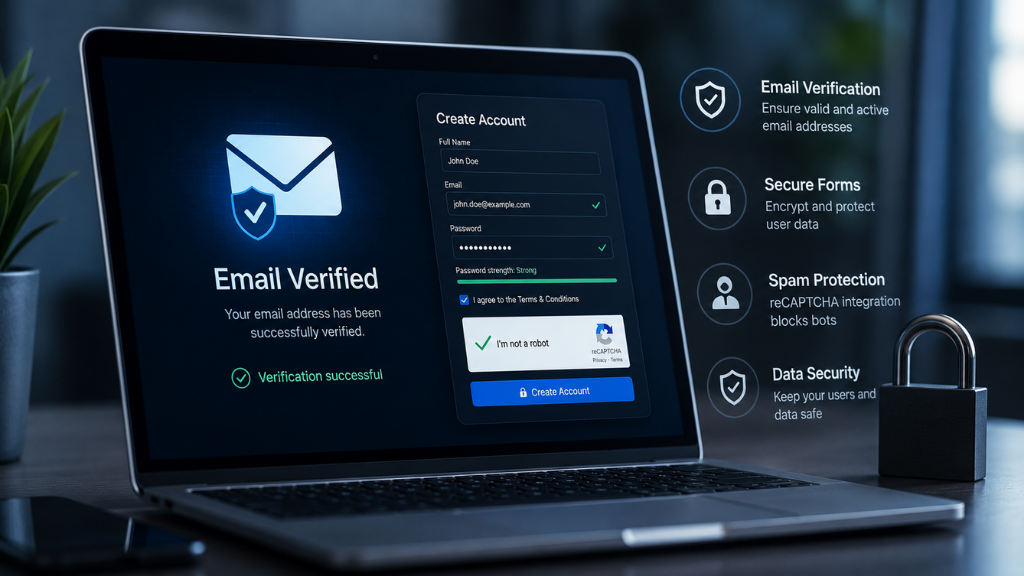
There was a time when a simple contact form was all a website needed. A visitor would enter their name, email address, message, click “Submit,” and the process was complete. It was fast, straightforward, and for many years, perfectly adequate.
Today, however, the landscape has changed dramatically.
Automation, bots, disposable email services, and increasingly sophisticated spam attacks have turned even the simplest contact form into a potential entry point for unwanted activity. For WordPress website owners—and especially WooCommerce store operators—the reliability of the information they collect is no longer merely a matter of organization. It is a matter of security, customer service, and ultimately, business credibility.
In this environment, verifying an email address during form submission is no longer an optional enhancement. It has become a fundamental requirement for the proper operation of any modern website.
The Problem Goes Far Beyond Spam
When people talk about form protection, spam is usually the first issue that comes to mind. While spam remains a persistent challenge, it represents only the tip of the iceberg.
An incorrect or non-existent email address can trigger a chain reaction of problems. A support request cannot be answered. A quotation never reaches the prospective customer. An order confirmation email bounces back as undeliverable. A customer assumes the business failed to respond, when in reality the issue began with a simple typing mistake made while completing the form.
Even more concerning, many automated scripts generate random or non-existent email addresses solely to test forms, create fake accounts, or overwhelm servers with hundreds of requests.
In other words, it is not enough to know that someone has submitted a form. You also need to know that they can actually be contacted.
The Illusion of Protection
Many website administrators believe they are already protected because they use CAPTCHA, honeypots, or services such as Google reCAPTCHA.
These technologies are undoubtedly valuable and continue to play an important role in website security. However, they serve a different purpose.
A CAPTCHA attempts to determine whether the entity interacting with the form is a human or an automated program. What it cannot determine is whether the email address entered is genuine, active, or actually belongs to the person submitting the form.
As a result, a form may successfully pass every security check while still storing a non-existent email address in the database.
Email verification closes precisely this gap.
The One-Time Password Approach
Over the past few years, One-Time Passwords (OTPs) have become standard practice across virtually every digital service. Banks, e-commerce platforms, cloud services, and even social media networks rely on temporary verification codes to confirm that users genuinely have access to the email address or phone number they have provided.
The same principle can—and should—be applied to WordPress forms.
The user enters their email address and, before the form can be submitted, receives a unique verification code via email. Only after entering the correct code is the submission considered valid and the form successfully completed.
The entire process typically takes less than a minute, yet it provides an exceptionally valuable layer of reliability.
Why This Matters Even More in WooCommerce
In e-commerce, the importance of email verification becomes even greater.
Email is the primary communication channel between a business and its customers. Through it, businesses send:
- order confirmations,
- shipping notifications,
- invoices and receipts,
- payment instructions,
- return updates,
- account notifications.
If the email address is incorrect, this entire communication chain immediately breaks down.
Businesses frequently spend valuable time attempting to contact customers who simply mistyped a single character in their email address during checkout.
Email verification dramatically reduces these situations while significantly improving the experience for both customers and support teams.
A Small Step for the User, a Major Advantage for the Business
A common concern is that every additional step in a form reduces completion rates.
There is certainly some truth to this. An unnecessarily complicated process can discourage users. However, experience over recent years has shown that people have become thoroughly accustomed to verification procedures.
Receiving a six-digit verification code via email is now considered almost routine. Most users encounter it daily when using banking applications, streaming platforms, online shopping websites, or social media accounts.
When implemented properly, the process feels neither inconvenient nor intrusive. On the contrary, it reinforces a sense of security, professionalism, and trust.
More Than Just Security
Email verification is not solely about preventing malicious activity.
It also significantly improves the quality of the data an organization collects. This becomes particularly valuable when that information is used for:
- newsletters,
- promotional campaigns,
- CRM systems,
- marketing automation,
- customer support.
A database filled with inactive or fake email addresses reduces the effectiveness of every marketing campaign, increases bounce rates, and can even damage the sender reputation of the company’s mail server.
Today, data quality is one of the most valuable assets any organization possesses—and it begins at the very first point of entry: the form itself.
The New Reality of WordPress
WordPress remains the world’s most widely used content management system. Precisely because of its popularity, however, it is also a constant target for automated attacks.
Modern websites can no longer rely solely on the traditional security techniques that were sufficient a decade ago.
Layered security has become the new standard.
Firewalls, CAPTCHAs, honeypots, rate limiting, behavioral analysis, and email verification each protect different stages of the submission process. None of these technologies replaces the others. Instead, they complement one another, creating a comprehensive security framework capable of meeting today’s evolving threats.
Conclusion
Email verification in WordPress and WooCommerce forms is not another fashionable feature added for the sake of innovation. It is a practical solution to real-world challenges faced by modern websites every single day.
It ensures that users can genuinely receive the information being sent to them, significantly reduces spam, minimizes data entry errors, improves data quality, and strengthens the credibility of any business operating online.
At a time when digital trust has become increasingly valuable, confirming ownership of an email address before a form is submitted is no longer a luxury.
It is a small investment that prevents significant problems and contributes meaningfully to the reliability, efficiency, and long-term success of every modern website.